At 20:20:59 UTC on October 29, 2026, an attacker took control of Binance 14, one of Binance’s main Ethereum hot wallets. Three minutes and 24 seconds later, its 167,464 ETH and 1.6 billion USDT were gone. It was one part of a theft across at least ten blockchains that Binance puts at about $6.3 billion and says it will cover in full.
The takeover itself was public. For those three minutes, and for the 3 hours 49 minutes the attacker kept control, anyone could ask the Ethereum network one question about the wallet and get an answer that said it had been hijacked. We rebuilt the timeline block by block, then pointed our own monitoring at the moment of the takeover. The check failed on its first run.
What is known so far
- At least ten chains, starting with XRP. Binance dates the compromise to “around 2026-10-29 20:05 (UTC)” (Binance Update #2). TRM Labs traced about $6.36 billion out of its wallets across ten blockchains, most of it in about 20 minutes (TRM Labs), and Elliptic counts $6.43 billion across 11. The XRP Ledger went first. We checked it: five payments totaling 233.46 million XRP reached one address between 20:05:00 and 20:09:20 UTC. Bitcoin, Tron, Solana and others followed. Only the wallet in this post was taken over with a delegation; the rest sent funds through ordinary signed transfers.
- A fake job interview, then a stolen deployment token. Binance first said the incident “may involve a compromised DevOps engineer’s laptop, which allowed an attacker to gain access to a service container and submit unauthorized withdrawal transactions” (X, 02:25 UTC on October 30). At 08:47 UTC it said its investigation “has uncovered additional points of breach” and called this “a complex attack” (X). Co-CEO Richard Teng said the attacker “did not simply use one engineer’s permissions” (The Next Web), that the hack “was not carried out by one person” and that a “self-destruct mechanism” destroyed tooling and traces (Teng’s transcript). Binance says it has found “no evidence of any wallet private key leak”. Its initial report on November 3 fills in the path: a tampered Homebrew install exposed the wallet team in June, a fake job interview put malware on a second engineer’s computer in September, an internal AI tool let the attacker take over two wallet engineers’ machines on October 20, and on October 29 a container deployed with a stolen token reached the wallet signing service and started the theft (Binance’s initial report).
- About $6.34 billion, with $2.85 billion frozen. Those are Binance’s latest figures, which count assets frozen or intercepted. Elliptic has verified $2.84 billion frozen on-chain, almost all of it USDT and USDC. It says the attacker still controls about $3.23 billion in assets no issuer can freeze and began moving funds between blockchains on October 30.
- The FBI says North Korea did it. On October 31 the FBI said North Korea was responsible and named the activity TraderTraitor, the same name it gave the group behind the Bybit hack. TRM Labs had already attributed the theft to TraderTraitor with “high confidence”. Chainalysis reached the same view, citing stolen funds it saw mixing with funds from last month’s Bitget exploit. Binance has not named anyone itself.
- What Binance has done. It “revoked the affected address authorisation”, engaged law enforcement and started a security review across the company. It began reopening withdrawals in phases on November 1, starting with Bitcoin, and says deposits were never affected. It set aside more than $6.34 billion to cover losses (Binance Update #2) and says 98% of the stolen token assets had been replaced by October 31, with the rest being bought. On November 3 it published initial findings and said independent security firms will review the incident (Binance’s initial report).
The rest of this post is about the one wallet that was delegated. Elliptic puts the Ethereum losses at $3.80 billion, of which $174 million came from a second wallet. That leaves about $3.6 billion for this one, more than half of the whole theft.
What the chain shows
Binance 14 is 0x28C6…1d60. These are the moments that matter, from our own queries of Ethereum mainnet. Times are block times in UTC on October 29 unless marked.
| Block | UTC | What happened | Tx |
|---|---|---|---|
| 26,299,449–690 | 15:59:11–16:47:23 | The rehearsal. Address 0x7c86…5ca0 deploys the sweeper contract, points a test wallet at it and sweeps that wallet, about four hours before doing the same to Binance. | tx |
| 26,300,752 | 20:20:47 | An ordinary wallet: its code is empty (0x). It holds 167,445 ETH and 1.61 billion USDT. | |
| 26,300,753 | 20:20:59 | The takeover. Address 0x7c86…5ca0 sends one transaction carrying 50 EIP-7702 authorizations for the wallet. One is valid, and the wallet’s code becomes 0xef0100 followed by the address of a sweeper contract. | tx |
| 26,300,754–769 | 20:21:11–20:24:11 | Nothing else visible changes. Deposits keep arriving, and the wallet keeps sending transactions of its own. | |
| 26,300,770 | 20:24:23 | First sweep. 0x7c86…5ca0 calls the wallet, which now runs the sweeper’s code. 167,464 ETH and 1,615,409,499 USDT leave; 1 ETH stays behind. The USDT goes to 0x5227…2f8c. Elliptic values the whole transaction at $2.53 billion. | tx |
| 26,300,772 | 20:24:47 | A second hot wallet, no takeover. Binance 16 (0xDFd5…963d) sends 28,006 ETH, 55.7 million USDT, 25.9 million RLUSD and other tokens to the same attacker address in ordinary signed transfers. Its code stays 0x. | tx |
| 26,300,855 | 20:41:23 | Second sweep: 780 million USDC, pulled from a separate Binance smart account (0xEe7a…4055) that this wallet controlled. | tx |
| 26,300,945 | 20:59:47 | Third sweep: another 43 million USDC from the same smart account. | tx |
| 26,300,946–960 | ~21:01 | Tether freezes 0x5227…2f8c, and Circle freezes its USDC at 21:04 (TRM Labs). USDT’s own blacklist shows the address clear at block 26,300,945 and blocked by 26,300,960. | |
| 26,300,968 | 21:04:23 | Fourth sweep: 1,700 ETH and 3.9 million USDT that arrived after the first. | tx |
| 26,301,161 | 21:42:59 | 200 million USDT arrives in the hijacked wallet from 0x2213…2f9e. | tx |
| 26,301,167 | 21:44:11 | Fifth sweep, 72 seconds later: 370 ETH and 200.4 million USDT. | tx |
| 26,301,444 | 22:39:35 | Sixth sweep: 128 ETH and smaller tokens, with the tokens going to a new address, 0xA97b…8d10. | tx |
| 26,301,729–819 | 23:36:47–23:54:59 | Five more calls from the attacker move nothing. | |
| 26,301,828 | 23:56:47 | Seventh and last sweep: 2,962 ETH. | tx |
| 26,301,896 | Oct 30, 00:10:35 | The revoke. The wallet sends itself a transaction with one new authorization that clears the delegation, and its code is 0x again. This matches Binance’s statement that it revoked the authorization. | tx |
This is every transaction the attacker sent to the wallet after the takeover, 12 in all, taken from the full history of 0x7c86…5ca0, the only address the sweeper lets drain the wallet (Blockaid). Amounts come from each transaction’s token and internal transfers, and most sweeps also took smaller tokens we do not list. Add the second hot wallet and our totals match TRM Labs’ Ethereum figures of 200,630 ETH and 1.875 billion USDT, and Elliptic’s count of the sweeps agrees.
Three numbers stand out. The first sweep came 3 minutes 24 seconds after the takeover. The takeover lasted 3 hours 49 minutes. And the attacker came back six more times, taking 823 million USDC, 204.3 million USDT and about 5,160 ETH. That is more than $1 billion in stablecoins, and the first of it left 20 minutes after the takeover.
Why one question gives it away
Since Ethereum’s Pectra upgrade in May 2025, an ordinary account can point itself at a smart contract by signing an authorization, a feature called EIP-7702. From then on, any call to the account runs that contract’s code. Wallets use it for features like batching. This attacker used it to give Binance’s wallet a new function that sweeps its ETH and tokens such as USDT to the attacker, leaving 1 ETH behind, and that only the attacker can call.
The authorization leaves a mark. Ask any Ethereum node for the account’s code with eth_getCode: an ordinary account returns 0x, and a delegated one returns 0xef0100 followed by the 20-byte address it delegates to. The answer is public, costs nothing and changes in the same block as the takeover. Very few attack steps can be seen from outside the victim’s systems. This one can.
It also fits what is known about the cause. An authorization has to be signed for the wallet, but not necessarily by someone who holds the key: whoever can get the wallet’s signing service to sign can produce one. TRM Labs reads it the same way: wallets with different chains, key types and signing schemes all signed for the attacker, which it says points to Binance’s hot wallet signing system. Blockaid noted that the attacker sent 50 authorizations at once, each for a different nonce, because it could not know which nonce the busy wallet would be on when the transaction landed. One matched.
We pointed our monitoring at the takeover
Ethereum nodes answer eth_getCode for past blocks too, so the takeover can be replayed against a real check. On October 30 we created HTTP checks in our own Site Qwality account. Each sent the same request to a public Ethereum endpoint, with the block number pinned, and asserted that the answer was 0x:
- Block 26,300,752, 12 seconds before the takeover: the result was
0xand the check passed. - Block 26,300,753, the takeover: the check failed on its first run, the automatic rechecks from a second cloud failed too, and the monitor went to failed, which is what sends the alert. That was 41 seconds after we created it.
- The latest block: the check passed, because Binance has revoked the delegation.
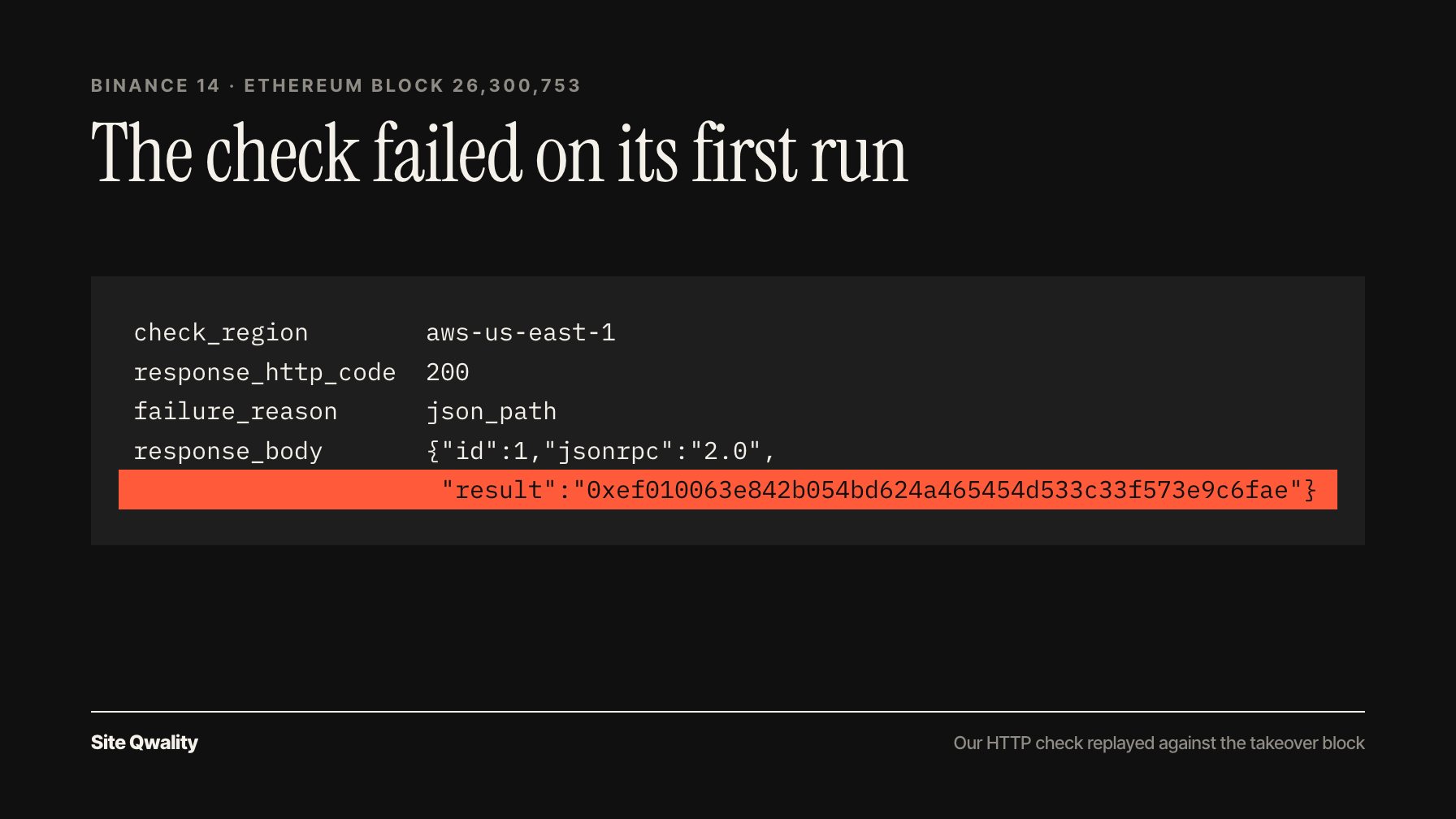
This is the failing result as our API returned it. The dashboard shows the json_path failure reason as “JSON path mismatch”.
check_region        aws-us-east-1
response_http_code  200
failure_reason      json_path
response_body       {"id":1,"jsonrpc":"2.0","result":"0xef010063e842b054bd624a465454d533c33f573e9c6fae"}
Run every 30 seconds against the latest block, the same check would have failed on its first run after 20:20:59, at most 30 seconds later. That is close to three minutes before the first sweep, 20 minutes before the USDC left and nearly four hours before the revoke.
How to set up the alert
This is now the expert advice too. TRM Labs’ report on the hack tells treasury teams to “monitor Ethereum-compatible wallets for EIP-7702 delegations, which appear as code at an address that should have none”, and says any such delegation “should trigger an immediate alert”. Here is one way to do it.
You need the address of each hot wallet you want to watch, an HTTPS JSON-RPC endpoint for the chain (your own node, or your node provider’s endpoint; a public endpoint is fine for trying it) and a Site Qwality account. 30-second checks and more than one check location need a paid uptime plan; the free plan checks every 5 minutes from one location.
- Add an HTTP monitor. Name it after the wallet, such as “Hot wallet 1 code”, and enter your RPC endpoint in URL or IP.
- Set the request. Under Request, set Method to
POST, Content Type to JSON and Request Body to:{"jsonrpc":"2.0","id":1,"method":"eth_getCode","params":["0xYOUR_HOT_WALLET","latest"]} - Add the assertion. Under Advanced, set JSON path to
$.resultand JSON path expected value to0x. - Check often, from more than one place. Set Check Interval to 30 seconds and pick at least two check locations.
- Route it to someone who can act. Under Alerting, keep Confirmation Threshold at 1 and choose a notification group that reaches your on-call people, plus a signed webhook if you want your own systems to react.
- Repeat for each wallet, and on each EVM chain that supports EIP-7702 where you keep one.
Through the API, it is one request (see the HTTP check reference):
curl -X POST https://api.siteqwality.com/http/job \
  -H "Authorization: Bearer $SITEQWALITY_API_KEY" \
  -H "Content-Type: application/json" \
  -d '{
    "friendly_name": "Hot wallet 1 code",
    "uri": "https://YOUR_RPC_ENDPOINT",
    "method": "POST",
    "content_type": "json",
    "request_body": "{\"jsonrpc\":\"2.0\",\"id\":1,\"method\":\"eth_getCode\",\"params\":[\"0xYOUR_HOT_WALLET\",\"latest\"]}",
    "json_path": "$.result",
    "json_path_expected": "0x",
    "run_interval_seconds": 60,
    "run_interval_thirty_seconds": true,
    "timeout_ms": 10000
  }'
A few things make it better:
- Use two providers. One check trusts one endpoint. A second monitor against a different provider means a provider that lags or misbehaves cannot hide the change.
- If you use EIP-7702 on purpose, set the expected value to your own delegation,
0xef0100followed by your contract’s address in lowercase hex. The check then fails if the wallet ever points anywhere else. - Have the revocation ready. TRM Labs also advises keeping “a tested, pre-approved method for signing a revocation”. An alert only helps if you can act on it, and this delegation stood for 3 hours 49 minutes.
- Read the failure reason. “JSON path mismatch” means the code changed. A timeout or an HTTP error means the endpoint is down, which you also want to know but is not a takeover.
What an alert can and cannot do
- It does not depend on your own controls. Teng said the delegation “did not pass through our normal approval controls”, and that the attacker destroyed tooling and traces as it went (Teng’s transcript). Approval flows and internal logs are what an attacker inside your systems goes around. A check that asks a public node for the wallet’s code sees the result however the signature was produced, and it runs outside the systems the attacker is in.
- It does not stop a sweep by itself. Three minutes is short for a person and long for software. A webhook into a runbook that freezes outgoing transfers and refills for the wallet, and pages the team, fits inside it.
- The cheapest win is everything after the first sweep. At 21:42:59, 82 minutes after the takeover, 200 million USDT reached the hijacked wallet, and the attacker swept it 72 seconds later. The sender,
0x2213…2f9e, had made the same transfer three times in the previous five days, and days earlier it had received 1 billion USDT from a wallet Etherscan labels Binance Cold Wallet 28. It looks like a routine top-up reaching a wallet Binance no longer controlled, though Binance has not said so. Freezes by Tether and Circle caught those stablecoins this time, but ETH and smaller tokens have no issuer to call. Stopping refills to a wallet whose code has changed needs no access to the attacker’s contract, only to your own systems. - It watches one kind of takeover, and this attack used two. Only Binance 14 was delegated. A second hot wallet, Binance 16, sent 28,006 ETH and 55.7 million USDT to the same address 24 seconds after the first sweep, in ordinary signed transfers, and its code never changed. TRM Labs and Elliptic report the same on every other chain. XRP left about 16 minutes before this takeover, so this check would not have been the first alarm that night. Catching signed transfers takes withdrawal and balance monitoring on your own side. Watching the code is cheap, runs outside your infrastructure and catches the step that moved most of the money on Ethereum.
- An alarm is only as good as the revoke behind it. Binance’s report says an internal alert on large transfers fired before the Ethereum delegation was set, so detection was not what failed. Pausing withdrawals left the on-chain delegation in place, and the wallet’s MPC setup had no single key that could sign a revoke, so Binance had to develop a special procedure. The delegation stood for 3 hours 49 minutes, and the 200 million USDT refill arrived in that window. If your wallets can be delegated, write and test the revoke transaction, and know who can sign it, before an alert ever fires.
Same afternoon, different attack
Binance’s takeover came a little over three hours after the Polymarket DebugBear hack began, and nothing links the two. They do rhyme. In neither case is there evidence that the attacker stole a key. At Polymarket, a compromised monitoring script got the page’s own signer to sign; at Binance, by its own report, a container deployed with a stolen token got the wallet’s signing service to sign. When the signer is the target, watch what it signs and what it changes, from somewhere the attacker cannot reach.
Sources
- TRM Labs: North Korea steals USD 6.36 billion from Binance in the largest hack in history (October 29, 2026; figures as of 00:30 UTC on October 30)
- Binance: preliminary statement on X, announcement, service update, investigation update and Security Incident Update #2 (October 30, 2026), Update #3 (October 31, 2026), Recovery Update #4, new wallet addresses and withdrawal status (November 1, 2026)
- FBI: North Korea responsible for $6 billion Binance attack (October 31, 2026) and The Next Web: FBI blames the Binance hack on North Korea’s TraderTraitor group (November 1, 2026)
- Binance: 29 October security incident, initial findings and response update (November 3, 2026)
- Richard Teng: video update transcript on X (October 30, 2026)
- Elliptic: The largest theft in history (last updated October 30, 2026, 19:30 UTC)
- Chainalysis: Tracing the $6.4 billion theft to North Korea (October 2026)
- Blockaid: the sweeper contract and the 50 authorizations (October 29, 2026)
- CoinDesk: Potential multi-billion Binance hack hitting crypto markets (October 29, 2026)
- Blockhead: Binance halts withdrawals after multibillion-dollar hot wallet drain (October 30, 2026)
- TechCrunch: Binance pauses withdrawals as hackers suspected of stealing billions in crypto (October 29, 2026)
- The Next Web: Binance says its $6.3bn hack involved more than a compromised laptop (October 30, 2026)
- EIP-7702: Set Code for EOAs
- On-chain data: our own Ethereum queries for Binance 14 (0x28C6…1d60), the second hot wallet (0xDFd5…963d) and the attacker’s operator (0x7c86…5ca0), blocks 26,295,416 to 26,301,946, plus the XRP Ledger history of the receiving address.