In This Comparison
The monitoring landscape has changed
A few years ago, choosing a website monitoring tool was simple. You picked Pingdom or UptimeRobot, set up a few uptime checks, and called it a day. Modern tech stacks demand more. You need uptime monitoring, yes, but also log management, real user data, session replays, on-call scheduling, and incident response, all in one place.
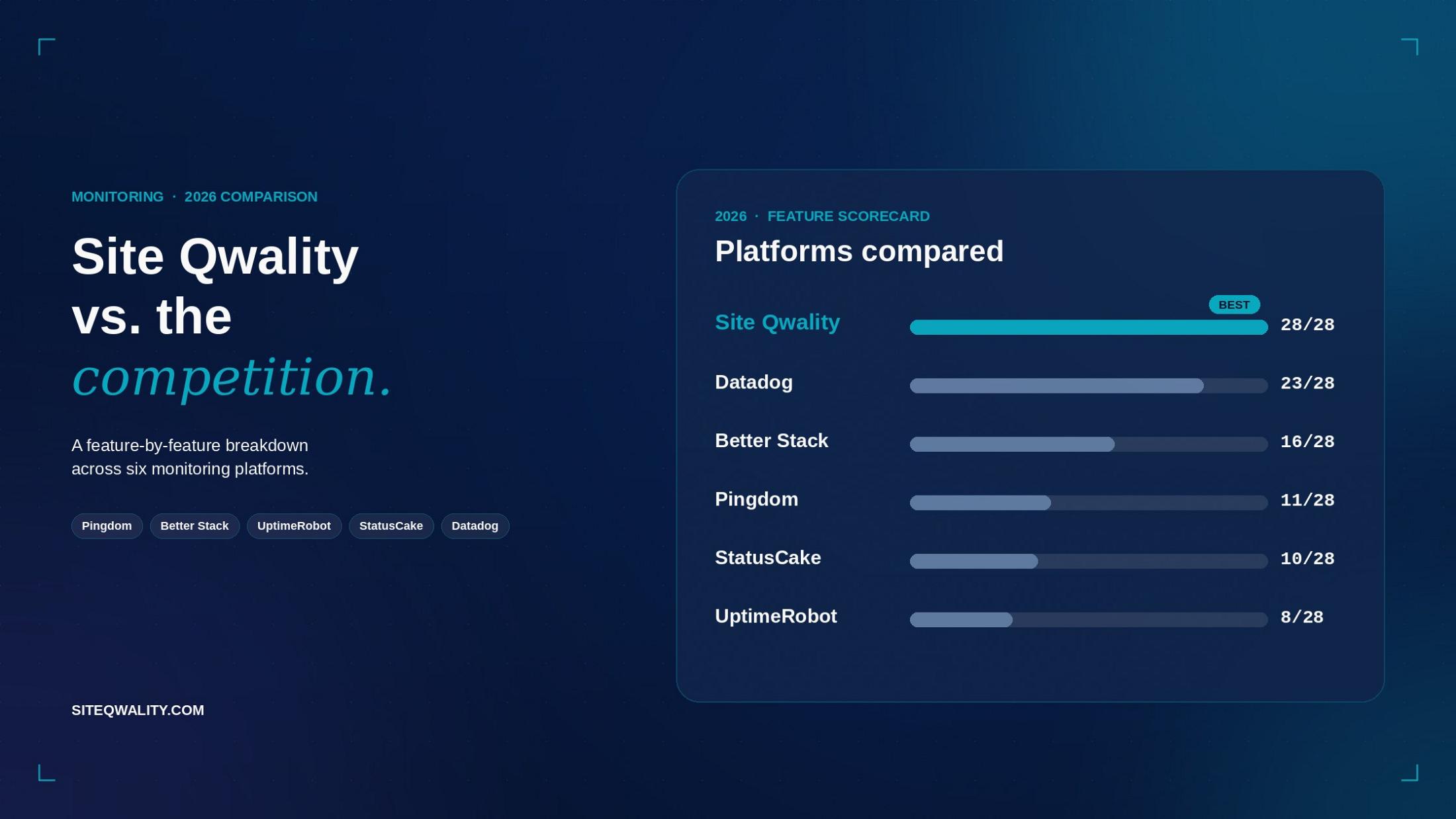
That shift is exactly what Site Qwality was built for. In this post, we compare it head-to-head against the five most commonly considered alternatives: Pingdom, Better Stack, UptimeRobot, StatusCake, and Datadog.
The question isn't just which tool monitors your site. It's which tool gives you the full picture without a sprawling, unpredictable bill.
The competitors at a glance
The original. Solid uptime and synthetic monitoring, but development has slowed since the SolarWinds acquisition and per-check pricing adds up fast.
Site Qwality's closest feature rival. Offers logs, on-call, and status pages. Strong product, but lacks session replay, distributed tracing, and a modular pricing model.
Great for getting started. No RUM, no APM, no on-call scheduling. Teams that outgrow basic uptime checks will hit a ceiling quickly.
Good performance diagnostics and domain monitoring, but no log management, no RUM, and no incident management beyond basic alerts.
Enterprise-grade power with an enterprise-grade price tag. Mid-sized teams routinely spend $50k to $150k a year. Each feature is a separate billable add-on.
Feature-by-feature comparison
Here is how all six platforms stack up across every major feature category. A couple of acronyms to define up front: RUM stands for Real User Monitoring, the technique of collecting performance data from actual visitors as they use a site. APM stands for Application Performance Monitoring, which tracks the internal behavior of an application's code and its dependencies in production.
| Feature | Site Qwality | Pingdom | Better Stack | UptimeRobot | StatusCake | Datadog |
|---|---|---|---|---|---|---|
| Uptime Monitoring | ||||||
| HTTP/HTTPS checks | ✓ | ✓ | ✓ | ✓ | ✓ | ✓ |
| Rapid check intervals | ✓ | ✓ | ✓ | 5 min free | Paid only | ✓ |
| Keyword monitoring | ✓ | ✓ | Basic | Basic | ✓ | ✓ |
| Regex / negative search | ✓ | · | · | · | · | Advanced |
| SSL/TLS monitoring | ✓ | ✓ | ✓ | ✓ | ✓ | ✓ |
| Domain monitoring | ✓ | · | Limited | · | ✓ | · |
| Cron job monitoring | ✓ | · | ✓ | · | · | Add-on |
| Synthetic monitoring | ✓ | ✓ | ✓ | · | Basic | ✓ |
| Page speed monitoring | ✓ | ✓ | · | · | ✓ | ✓ |
| Observability | ||||||
| Log management | ✓ | · | ✓ | · | · | ✓ |
| Metrics explorer | ✓ | · | Basic | · | · | ✓ |
| Distributed tracing / APM | ✓ | · | · | · | · | ✓ |
| Error tracking | ✓ | · | Basic | · | · | ✓ |
| Real User Monitoring (RUM) | ||||||
| Core Web Vitals | ✓ | ✓ | · | · | Limited | ✓ |
| Session replay | ✓ | · | · | · | · | Add-on $$$ |
| Session analytics | ✓ | Basic | · | · | · | ✓ |
| Incident Management | ||||||
| Status pages | ✓ | · | ✓ | ✓ | ✓ | Add-on |
| On-call scheduling | ✓ | · | ✓ | · | · | Add-on |
| Escalation policies | ✓ | · | ✓ | · | · | Add-on |
| Service catalog | ✓ | · | · | · | · | ✓ |
| Alerts & Integrations | ||||||
| Slack / Teams / Discord | ✓ | Slack only | ✓ | Slack only | Slack only | ✓ |
| Telegram | ✓ | · | · | · | · | · |
| SMS alerts | ✓ | ✓ | ✓ | Paid only | ✓ | ✓ |
| Webhooks / API | ✓ | ✓ | ✓ | ✓ | ✓ | ✓ |
| Pricing Model | ||||||
| Free tier | ✓ | · | ✓ | ✓ | Trial only | Very limited |
| Predictable pricing | ✓ | Per check | ✓ | ✓ | ✓ | · |
| No feature gating | ✓ | · | · | · | · | · |
| Modular / pay per product | ✓ | · | · | · | · | Yes, but costly |
Where Site Qwality stands out
Looking at the table above, a few exclusive advantages jump out immediately.
Regex & negative keyword search
No other competitor in this roundup offers regex-based or negative keyword detection. Critical for brand protection and compliance monitoring.
Session replay
Pixel-perfect recordings of real user sessions. Only Datadog offers this too, at a steep per-session add-on cost. Site Qwality includes it from the start.
Distributed tracing
Trace requests across services and APIs. Outside of Datadog, none of the direct competitors offer this.
Service catalog
Organize and document your services in one place. A feature usually reserved for enterprise observability platforms.
Telegram alerts
The only platform in this comparison with native Telegram integration, alongside Slack, Discord, and Microsoft Teams.
No feature gating
Every feature is available regardless of plan size. No paying more just to unlock things that should be standard.
The Datadog problem
Datadog deserves special attention because it is the only platform in this comparison that comes close to Site Qwality's feature breadth. The cost story is a completely different conversation.
Mid-sized companies routinely spend $50,000 to $150,000 per year on Datadog for full-stack monitoring. Enterprise deployments can easily exceed $1 million annually. Session Replay alone costs $2.50 per 1,000 sessions, billed on top of separate RUM, APM, log ingestion, and infrastructure charges.
The issue is not that Datadog is a bad product. It is genuinely powerful. The problem is structural: every capability is its own line item. Infrastructure monitoring, APM, log management, RUM, synthetics, session replay, incidents, all billed separately, often with volume-based pricing that compounds as you scale. Teams frequently discover mid-year that enabling a few new features has doubled their monthly bill.
Site Qwality offers comparable observability depth (logs, metrics, distributed tracing, RUM, session replay, incident management) at a fraction of the cost, with no hidden compounding charges.
Site Qwality vs Better Stack: the closest fight
Better Stack is the most direct competitive threat. Both platforms offer logs, on-call scheduling, escalation policies, status pages, and synthetic monitoring. If you are evaluating the two, the deciding factors come down to a few key gaps.
Site Qwality advantages over Better Stack
- Session replay. Better Stack does not offer it.
- Distributed tracing. Not available on Better Stack.
- Regex and negative keyword monitoring. Exclusive to Site Qwality in this lineup.
- Modular pricing with no feature gating. Pay only for what you use, with full access to every feature on every plan.
The Pingdom exit
Pingdom was the default choice for uptime monitoring for nearly two decades. Since the SolarWinds acquisition, development has slowed considerably while pricing has crept upward. Per-check pricing means monitoring even a moderate number of endpoints at tight intervals can run into hundreds of dollars per month, with no log management, no RUM, and no incident tooling to show for it.
For teams currently on Pingdom, the value proposition for switching is clear: more features, better pricing, and a platform that is actively being developed. We covered this matchup in more depth in our full Pingdom alternative breakdown.
Head-to-head verdicts
More features, no feature gating, free tier, active development. Pingdom's per-check pricing stings at scale.
Session replay, distributed tracing, and regex monitoring tip the balance. Modular pricing is also a meaningful differentiator.
UptimeRobot is fine for basic uptime checks. Any team needing RUM, logs, or incident management has outgrown it.
StatusCake covers uptime and page speed well, but has no log management, RUM, or incident tooling. No free tier either.
Datadog wins at deep enterprise infrastructure monitoring. For most teams, Site Qwality offers comparable observability at 10 to 20 percent of the cost.
Bottom line
The monitoring market in 2026 splits into two camps: tools that do one thing (uptime checks), and tools that try to do everything at enterprise prices. Site Qwality sits in a third position. It is a genuine all-in-one observability platform priced for teams that cannot justify a $100k-a-year Datadog contract but have outgrown the simplicity of UptimeRobot or Pingdom.
The free tier on every product means there is no reason not to try it. And the modular pricing model means you scale exactly what you need: no bundles, no tiers, no surprises.
See it for yourself
Every product starts free: uptime, cron, synthetic, logs, RUM, and more. No credit card required.
Start Free at Site Qwality